Educational guide
Why Your Peptides Gel Up (And What You Can Actually Do ...
You reconstitute your peptide perfectly. Clear liquid. Everything looks great. You store it in the fridge like you’re supposed to. Then a week later, you pull it out and... what the hell? It’s turned into a thick, gel-like substance. If this has happened to yo
This guide cannot diagnose a condition or recommend a personal treatment plan. Discuss medical questions with a qualified professional.
You reconstitute your peptide perfectly. Clear liquid. Everything looks great. You store it in the fridge like you’re supposed to. Then a week later, you pull it out and... what the hell? It’s turned into a thick, gel-like substance.
If this has happened to you, you’re not alone. It’s one of the most common questions I get, and honestly, it’s frustrating when you’ve invested time and money into your research only to find your peptide has transformed into something completely different.
So let’s talk about what’s actually happening, why it happens, and most importantly - what you can do to prevent it (and whether there’s any hope of saving a peptide that’s already gelled).
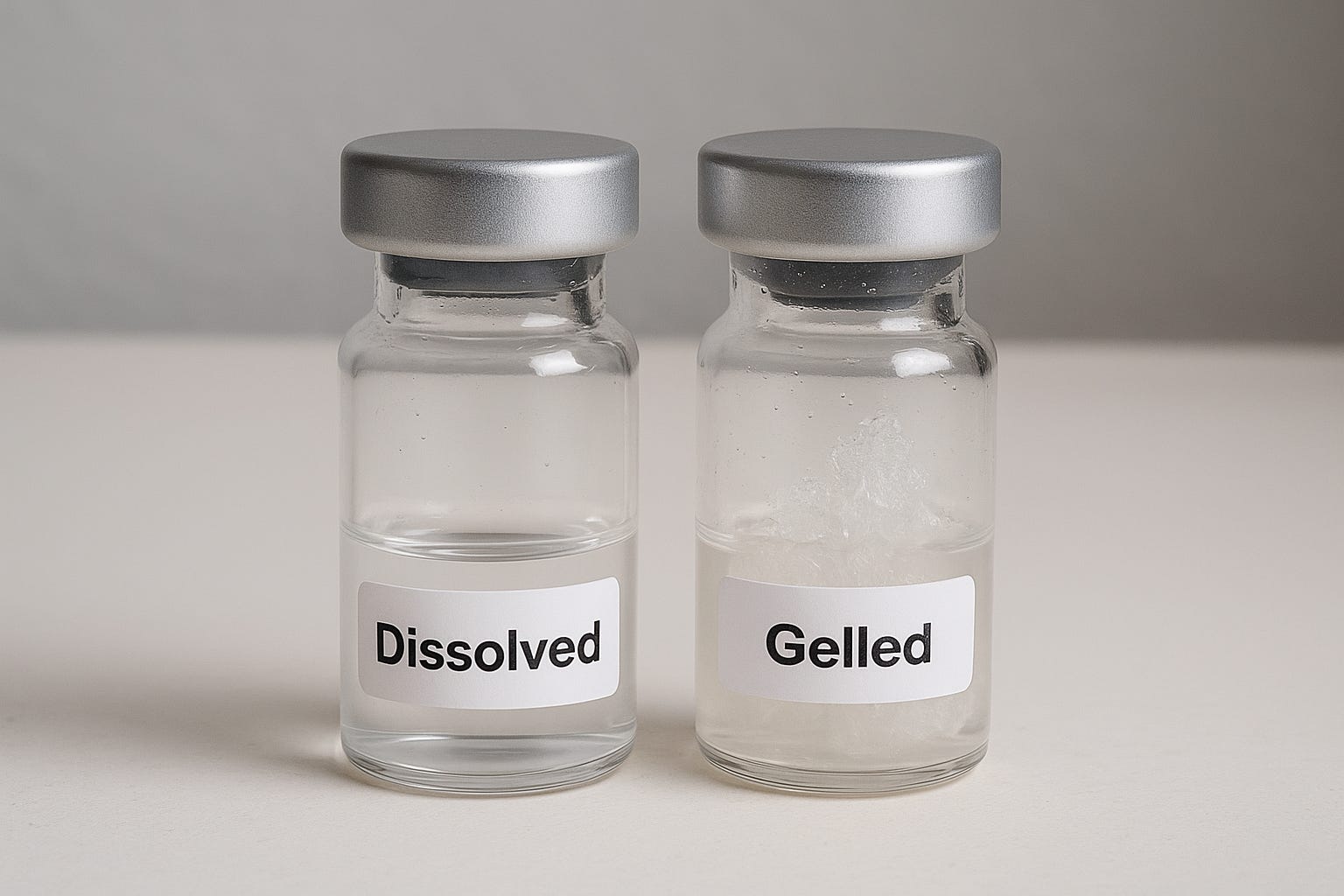
There’s a proper scientific term for this phenomenon: protein aggregation.
Here’s what’s happening at the molecular level: peptides are essentially short chains of amino acids that fold into specific 3D structures. When they’re in solution (mixed with bacteriostatic water), these structures need to stay stable. But when certain conditions change - temperature fluctuations, pH shifts, contamination - these peptide molecules start clustering together.
Think of it like a bunch of magnets floating in water. Under normal conditions, they stay separate and evenly distributed. But change the conditions enough, and they start snapping together into clumps. That’s basically what’s happening with your peptides.
When stored properly, reconstituted peptides should stay clear and liquid throughout their shelf life. If they gel up, something went wrong with storage or handling.
Let me be blunt: temperature fluctuations are almost always the culprit.
Peptides in solution are sensitive to temperature changes. Every time the temperature swings - especially with freeze-thaw cycles - the peptide structure unfolds, then refolds. But it doesn’t always refold correctly. Do this enough times and the molecules start sticking to each other, forming aggregates that eventually create that gel consistency.
The most common mistakes I see:
Taking the vial in and out of the fridge repeatedly. Every time you do this, you’re creating a temperature swing. The vial warms up, then cools down again. Over and over. This is brutal on peptide stability.
Storing near the freezer compartment. If your vial is sitting too close to the freezer section, it’s probably experiencing more temperature variation than you think. The fridge door is even worse - every time someone opens it, that area experiences the biggest temperature swing.
Leaving it out too long. I get it, you’re drawing your dose and maybe prepping other things. But every minute that vial sits at room temperature is another opportunity for degradation.
Shipping during extreme weather. This is harder to control, but if your peptides are being shipped in summer or winter without proper insulation, they’re getting cooked or frozen in transit.
Accidentally freezing reconstituted peptides. This is the nuclear option for peptide destruction. Once a reconstituted peptide freezes, you’re pretty much done. The ice crystals physically disrupt the protein structure.
The fix? Keep your peptides in the main compartment of your fridge (ideally 2-8°C or 36-46°F), away from the door and freezer. Draw what you need quickly, then get the vial back in the fridge. Minimize handling time.
Temperature is the big one, but there are other things that can cause or accelerate aggregation:
Concentration matters. Higher concentration peptides have more molecules packed into less space. More opportunities for collision, more opportunities for aggregation. This is why some researchers dilute further if they’re having issues - fewer molecules per volume means less chance of them bumping into each other.
pH can shift. Peptides are stable within specific pH ranges. If your bacteriostatic water isn’t properly buffered, or if contamination introduces pH changes, this can trigger aggregation. Different peptides have different sweet spots.
Contamination is sneaky. If bacteria get into your vial - from reusing needles, poor sterile technique, or just bad luck - they produce enzymes and metabolic byproducts that can destabilize your peptide solution. This is why proper technique matters.
Time works against you. Even under perfect storage conditions, reconstituted peptides don’t last forever. Most are good for 28-30 days refrigerated. After that, slow aggregation starts happening even if you do everything right. Don’t try to stretch it.
Light degrades peptides. UV light causes structural damage. This is why peptides often come in amber vials, and why you should keep them in the box or wrapped in foil during storage.
Rough handling accelerates the problem. Shaking your vial might seem harmless, but excessive agitation causes molecules to collide more frequently. That’s why the protocol is to gently swirl, not shake.
The good news? This is almost entirely preventable if you’re diligent about storage and handling.
Here’s your checklist:
Stable temperature is everything. Main compartment of the fridge, away from the door and freezer. Consistent 2-8°C. This is non-negotiable.
Minimize handling time. Draw your dose, get the vial back in the fridge. Don’t let it sit out while you’re doing other prep work.
Use fresh needles every single time. No exceptions. Reusing needles introduces contamination risk that can destabilize your peptide over time.
Inject bacteriostatic water slowly down the side of the vial. Don’t blast it directly onto the lyophilized powder. Gentle reconstitution reduces aggregation risk from the start.
Protect from light. Keep vials in their original packaging or wrap in foil if they’re clear glass.
Respect the 28-30 day window. After reconstitution, you’ve got about a month. Plan your research accordingly and don’t try to push it beyond that.
The million-dollar question: if your peptide has already started to gel, is there anything you can do?
The answer is: maybe, if you catch it very early.
Gentle warming: If you’ve got mild cloudiness (not full gel), you can try letting the vial sit at room temperature for 20-30 minutes, then gently swirl. The idea is to give the molecules enough kinetic energy to potentially separate. If it clears up, immediately refrigerate and prioritize that peptide for research over the next few days.
Does this work? Sometimes for mild cloudiness. Rarely for anything more advanced.
Light dilution: Some people add 0.1-0.2ml of additional sterile bacteriostatic water to reduce concentration and potentially reduce aggregation. Keep in mind this changes your concentration calculations for research purposes.
Wait and see: Occasionally, very mild cloudiness will settle on its own after sitting undisturbed in the fridge for 24 hours. Don’t count on it though.
Here’s my honest assessment: if you’re dealing with mild cloudiness caught early, gentle warming is worth ONE attempt. If it works, great - use that peptide soon and fix your storage practices. If it doesn’t work, or if you’re dealing with a fully gelled peptide that’s turned thick or solid, the molecular structure is compromised. Start fresh.
This depends on severity.
If your peptide has fully gelled into a thick or solid mass, the protein structure is clearly compromised. The aggregation means the peptides aren’t in their proper functional form anymore. Research efficacy is questionable at best.
If it’s just slightly thicker than normal or has some mild cloudiness, it might still have some activity. But you’re rolling the dice on potency and consistency. You don’t know how much has aggregated versus how much is still viable.
My take: when in doubt, start fresh. Fix your storage issues so it doesn’t happen again. You want reliable, consistent research - not guesswork about whether your peptide is still functional.
Peptides gelling is almost always a storage and handling issue. Temperature fluctuations are the primary cause, with contamination, pH changes, light exposure, and time as contributing factors.
The good news? This is preventable. Keep your temperatures stable, minimize handling, use proper technique, protect from light, and don’t push the storage timeline.
If your peptide has already gelled, you can try gentle warming for mild cases, but full aggregation means you need to start over with a new vial and better storage practices.
Your reconstituted peptides should stay clear and liquid throughout their usable life. If they don’t, something in your process needs adjustment.
Have you dealt with peptide aggregation? What storage practices work best for you? Drop a comment - I’d love to hear what’s worked (or hasn’t worked) in your experience.
-Derek Peptide Price
No posts