Educational guide
Peptide power-laws - Chief Longevity Officer
In a post-AGI world, I predict your body becomes the last asset class. Think about it, when people live inside volatile systems, when they can’t afford homes, when their jobs are threatened by AI, the body becomes the most intimate place to regain leverage. Wh
This guide cannot diagnose a condition or recommend a personal treatment plan. Discuss medical questions with a qualified professional.
In a post-AGI world, I predict your body becomes the last asset class.
Think about it, when people live inside volatile systems, when they can’t afford homes, when their jobs are threatened by AI, the body becomes the most intimate place to regain leverage.
When the world’s currency feels unstable, people move assets into something they can touch.
In a bio-psychological sense, the body becomes that asset.
Every asset class follows the same arc:
First, it’s discovered/created
Then, it’s controlled (who can access, who can trade, who sets the rules)
Then, it’s financialized (markets, speculation, gatekeepers)
Then, power consolidates around whoever controls access
Think oil, real estate, data..
So if the body becomes an asset class, then who controls it?
Is it the government? Big Pharma? Big food? Physicians? The Grey Market?
We’re living in a game of thrones, each house fighting for the iron throne (your body),
subtly stacking leverage wherever they can - brand, data, speed, trust, regulations, supply chain control…
Some are playing the long game while some grab for power now.
Let’s anchor this in a space that is blowing up where you can see this playing out,
Peptides.
The FDA arbitrarily classifies anything under 40 amino acids a peptide, anything over that a biologic, & over 100 amino acids a protein.
Everything from insulin, oxytocin, to collagen, is a peptide,
& so are the GLP-1 drugs that made Eli Lilly a trillion dollar company.
When you zoom out on why peptides are exploding, you realize people really just want to purchase control. They need desperately a way to convert uncertainty into action.
This, coupled with people's loss of faith in trad healthcare, is driving them to build a parallel system.
Johns Hopkins data shows physician trust dropped from 71.5% to 40.1% between 2020 and 2024.
FDA trust from 65% to 53%.
The entire system is collapsing.
Hence, peptides are the hottest consumer category of 2026.
& the consumer demand is outpacing regulations at an egregious rate.
LegitScript recently saw a 208% surge in advertising for peptides.
More than 50 million TikTok videos are tagged with peptides.
120 BPC-157 suppliers are listed on Alibaba alone...
The past month was an absolute shit-show, especially after RFK’s stint on Joe Rogan announcing that 14 peptides are moving from category 2 to category 1.
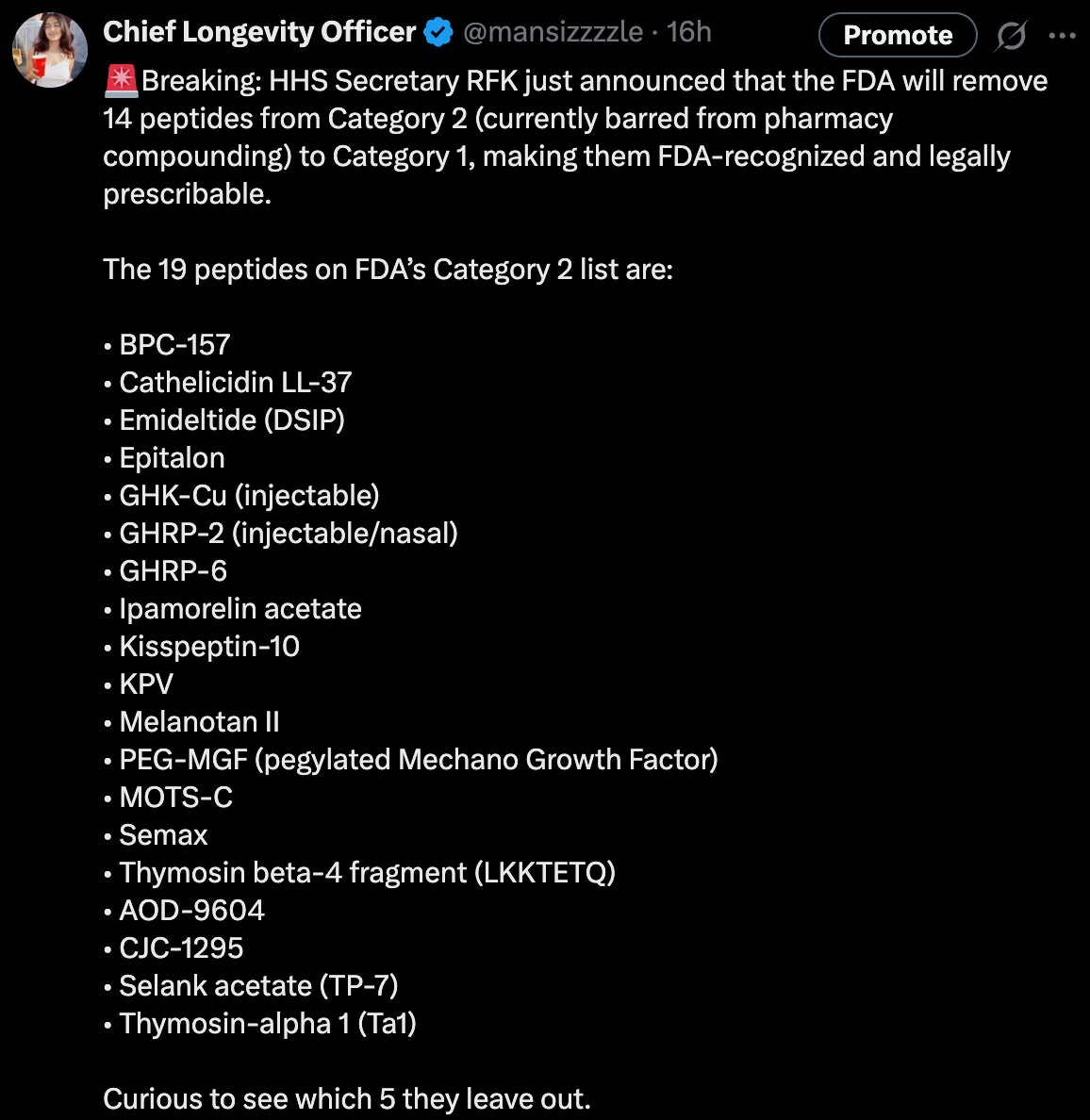
And a week after on March 27th, the FDA had a 6-Hour meeting to discuss supplements, & peptides were mentioned 36 times.
Since then I’ve had some pretty interesting calls, from a friend building bio-enhancing peptides for combat-recovery, an RUO supplier who password-protected their site in fear of being shut down, a longevity clinic shifting from RUO to compounded peptides, & a private equity bro rolling up compounding pharmacies.
Everyone is jumping in from all angles.
& the question is — who’ll end up with the throne?
Right now, China is the obvious winner.
Before BPC-157 ends up in someone’s thigh in a TriBeCa high-rise loft, it starts in China.
5 Companies in China control roughly 88% of the global supply of protected amino acids — the raw building block of a peptide.
The protected amino acids market is a $1.5 billion industry.
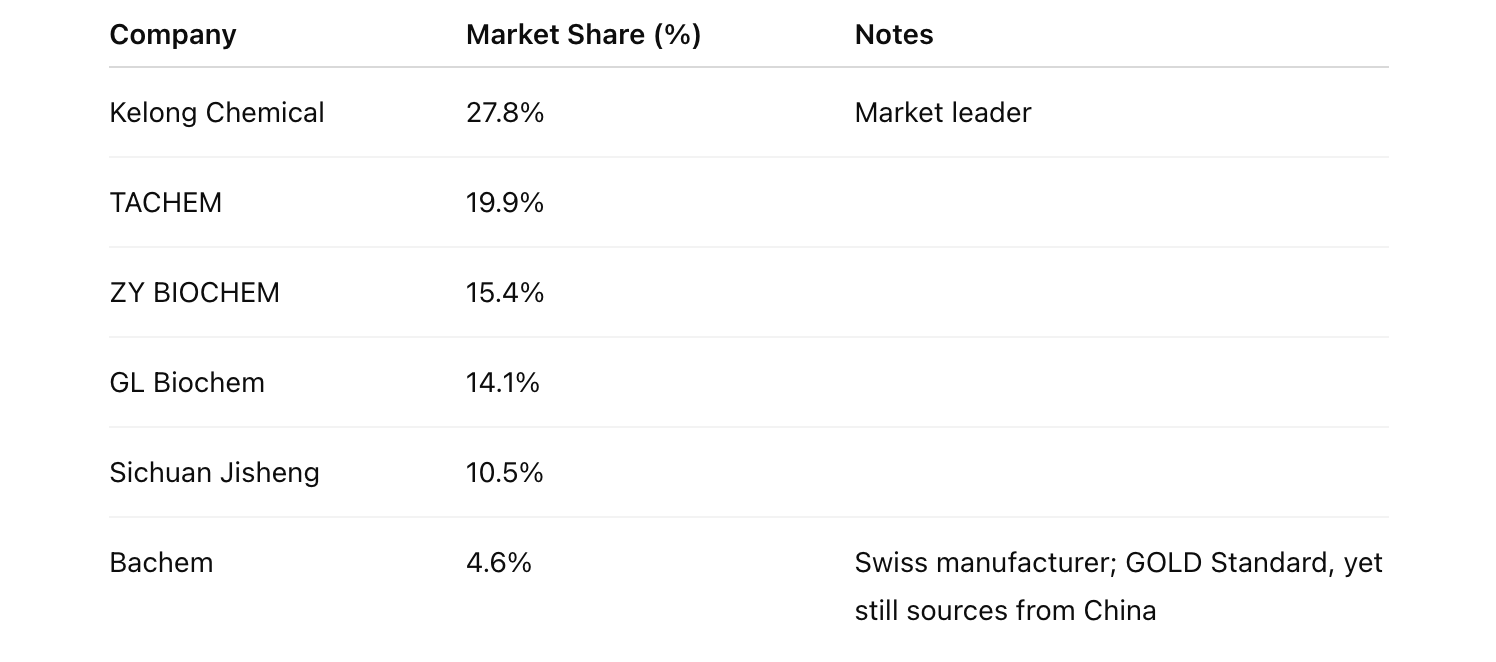
Table showing marketshare of protected amino acids.
Beyond protected amino acids, China supplies the other essential inputs like the resins, the coupling reagents, & the solvents.
China is the horny finance bro at the Spaniard in NYC on a Thursday, the dude will hit on everyone.
He’ll sell to Eli Lilly’s contracted CDMOs, 503B & 503A compounders, and the grey market Telegram vendor. China has no loyalty.
& they all happily pull from the same upstream Chinese infrastructure.
China also controls Synthesis, they use something called Solid Phase Peptide Synthesis reactors (SPPS. for short).
The main issue during synthesis is efficiency.
The error rate compounds with every amino acid you add to the chain.
BPC-157 at 15 amino acids comes out correct around 74% of the time.
Semaglutide at 31 amino acids comes out correct just 55% of the time.
The longer the peptide, the worse the yield, and the more critical it becomes to run tight quality control.
& this is why China wins.
To compensate you need massive scale.
You synthesize far more than you need, knowing a significant portion will be incorrect, and then you separate the correct molecule out in purification.
China has this at scale. The US does not.
WuXi TIDES alone now has over 100,000 liters of SPPS reactor capacity. In 2023 alone they produced more than 15 metric tons of peptide APIs.
The largest peptide manufacturer in the US is CordenPharma in Boulder, Colorado. Their flagship vessel is 10,000 liters — considered uniquely large-scale & recognized as one of the largest peptide API producers worldwide.
WuXi alone has 10x that.
& WuXi is one of several Chinese manufacturers operating at this scale. The entire US peptide manufacturing industry combined doesn’t come close to what a single Chinese CDMO built in response to GLP-1 demand.
China built this capacity instead of the US because of government subsidies, lower labor costs, a favorable tax environment, and a much faster regulatory process.
They’ve built a massive structural dependency, and the entire world sources it’s API (Active Pharmaceutical Ingredients) from them.
China is obviously the closest thing to a winner right now, yet most people in this debate are focused on:
Big Pharma
They’ll come in second.
Probably.
But people are losing faith in this player, & for good reason.
The pharmaceutical industry has slowly eroded public trust over time.
The clearest example of this I can remember is the opioid crisis, when Purdue Pharma marketed OxyContin aggressively for chronic pain conditions it was never intended for, & buried the addiction risk. The opioid crisis that followed costs us $78.5 billion annually.
Medicine has always been a field of siloed training, dominated by the same industry that had every incentive to keep doctors prescribing & patients dependent.
& nobody has really ever tried to treat the body as a whole, until now.
There’s a palpable shift in the space, & I know you can feel it too.
The trend that I’m noticing is that every biotech start-up is trending consumer, while every consumer is trending biotech.
Once you own both the IP, the distribution, & the patient data, every channel opens up to you.
But… pharma has played this game longer than anyone.
Eli Lilly is the largest pharmaceutical company in the world by market cap, built almost entirely on the back of one drug class — the same one that briefly made Novo Nordisk the most valuable company in Europe before it lost significant altitude.
GLP-1s.
Novo has Ozempic, Wegovy, Rybelsus
Lilly has Mounjaro, Zepbound, Orforglipron, & soon Retatrutide
These GLP-1 products are set to bring in $470 billion by 2030.
& right now, they’re on an acquisition spree until they own the whole stack.
Since 2023, Lilly alone has spent over $25 billion in acquisitions. Each one a bet on a different human system.
Metabolism. Cancer. Cardiovascular. Inflammation. Pain. & now sleep — Centessa Pharmaceuticals, $6.3B upfront & another $1.5B in milestones, for a drug that regulates the entire sleep-wake cycle.
The people stacking BPC-157 & Cerebrolysin in TriBeCa lofts & the people running Lilly’s M&A desk are betting on the same thesis, bioenhancement.
But pharma just has patents,
& that is how they protect all of it.
Novo has filed 320 patent applications for semaglutide, been granted 154 — two compound patents originally expiring March 2026 extended to 2031, Lilly’s tirzepatide principal patent runs to 2036.
There’ll always be a monopoly.
The biggest argument from pharma right now is that people are injecting themselves with peptides for issues they don’t have. That we should only use drugs approved for specific indications.
But that’s because big pharma can’t patent most peptides, there’s no incentive to fund trials. No IP path means no return on investment. So the clinical data gap is also a market strategy.
Pharma also has a chokehold on the government.
Insiders tell me Lilly called TrumpRx directly when Hims planned to release orals mimicking Novo’s Wegovy, & threatened to pull out unless TrumpRx warned Hims to back off from big pharma.

Pharma trade associations run the largest political action committees on the planet, & right now. they have an insane betting chip:
The MOU — Memorandum of Understanding, is a contract between individual states & the FDA that has been sitting in federal law since 1997, ignored until now.
If a state signs it, every compounding pharmacy in that state gets hit with a hard cap — no more than 5% of their total prescription volume can ship out of state.
Most 503A compounders doing national telehealth volume right now are shipping 80-90% out of state.
If the MOU goes through, the FDA can treat every pharmacy in that state as though they’ve already exceeded the cap — which hands them federal enforcement authority over all out-of-state shipments.
Pharma doesn’t need a single new law.
The mechanism already exists. They just need enough states to sign.
And Indiana is leading, Lilly’s home state.
I predict Pharma secures MOU activation in at least 3 states by end of 2026.
I’d watch Indiana, Ohio, California.
& on then April 2nd, 2026, Trump signed an executive order imposing 100% tariffs on imported patented pharmaceuticals & their APIs.
Companies that sign Most Favored Nation pricing agreements with HHS & onshoring agreements with the Department of Commerce pay 0% tariff.
Almost every major drugmaker has already signed.
& the tariffs on APIs (the raw pharmaceutical ingredients) apply to everyone sourcing from China, including compounders who have no pathway to sign an MFN deal because they’re not a pharmaceutical company.
$400 billion in new investment commitments from pharma have already been announced.
Insiders from TrumpRx tell me this is a pressure tactic for their own negotiations.
& just a few days ago, I spoke to an HHS insider who told me Eli Lilly is going absolutely nuts with the peptide wars
First of all, they are pushing the FDA to reclassify the glp-1s as biologics instead of peptides so that:
1. Compounding pharmacies can’t touch them, as they’re not allowed to dispense biologics. Only large manufacturers contracted by big pharma can produce biologics
2. They can extend the patents by 10-15 years min
The FDA classifies anything under 40 amino acids a peptide, over 40 a biologic
& they’re pushing extremely hard on Retatrutide
Retatrutide sits at 39 amino acids, technically a peptide. But the argument they’re pushing is that certain side chains should be counted as amino acids, pushing it over the peptide threshold
This strategy has precedent since pharma already used it to push fertility compounds like HCG, FSH & HMG into the biologic classification, removing them from the compounding pathway
Patents expire, but the classification system doesn't
Compounding Pharmacies (503A and 503B)
Compounding pharmacies are the infrastructure layer that a lot of the peptide and GLP-1 market is built on.
They’ve been around forever.
Think your local village pharmacist, pestle in hand, crushing herbs into paste & distributing sachets across the village.
Obviously they've evolved since then. But the fundamental model — customizing medicine for the individual patient — never went away.
& right now that model is at war with the entire pharma industrial complex.
There are two types of compounding pharmacies,
503As, which compound to order for individual patients, & drop-ship to patients through patient specific scripts. They’re regulated by state pharmacy boards + the FDA.
503Bs, which operate under direct FDA oversight, follow the same manufacturing standards as commercial drug companies (cGMP standards), & produce at commercial scale for distribution to hospitals, & large healthcare providers. 90 exist in the entire US, & what they can compound depends on whether the drug is on the FDA shortage list, or whether the bulk substance is on the 503B bulks list.
Compounded meds are much cheaper than pharma grade & this deep pricing gap built the entire player.
& the compounders move fast — already shilling Retatrutide making millions while Lilly hasn’t even finished phase 3 clinical trials.
A bare compounding pharmacy in Texas runs $200-300K to acquire, but the licensing alone runs $1.5M.
A well-licensed pharmacy generating some revenue is probably $20M-$50M.
Healthcare-focused PE has a real advantage here because they can absorb the licensing costs most operators can’t.
And the acquisition activity in this space is pretty fat.
Revelation Pharma, backed by Osceola Capital, has done 9+ acquisitions since 2021.
Empower Pharmacy in Houston, the largest compounder in the US, runs both 503A & 503B (one of fewer than 50 in the country doing both).
Their revenue estimated at $126-184M.
& then two day ago after RFK’s announcement on April 1st, 2026 — Noom acquired Tailor Made Compounding. 503A, 46 states including California. Their largest acquisition ever.
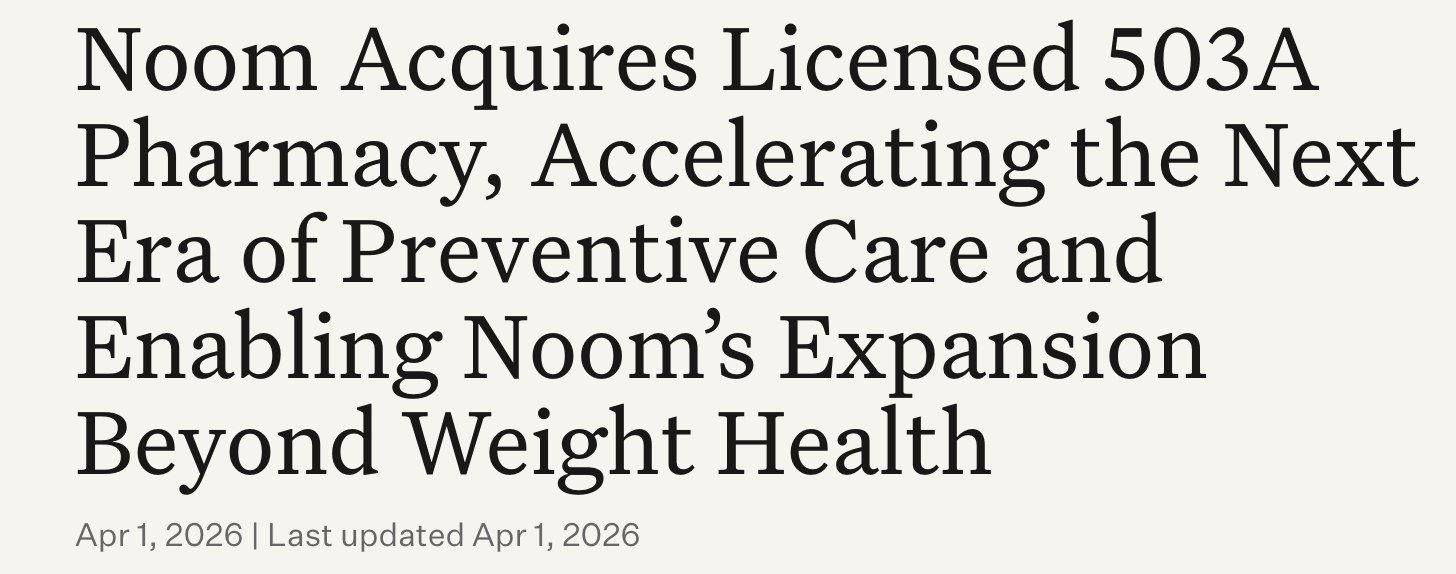
The race to hold licenses before the door slam open is getting hot.
The compounding industry scaled really fast, and after years of allowing compounders to flood the market with bespoke weight-loss drugs, how does the FDA put the genie back in the bottle — especially without risking another shortage?
Smart operators are already finding their exits.
A friend of mine runs an RUO peptide company & just bought a compounding pharmacy in Texas for exactly how the state’s structure works. Two separate legal entities — one pharmacy, one lab. The pharmacy follows standard rules. The lab operates under research-use labeling, completely outside the compounding designation. Categories that would be off-limits through the pharmacy route through the lab instead.
There’s a ton of state-level regulatory arbitrage to milk if you know where to look.
Ohio & California are the hardest.
California alone requires two separate licenses for sterile compounding, a mandatory physical inspection before issuance, & an independent pharmacist verification requirement that exists nowhere else in the country. Getting licensed in California is itself a moat.
TMC having it across 46 states including California is partly what Noom paid for.
Prediction: The market bifurcates.
The Empower-tier 503Bs with political relationships & real infrastructure will survive. The smaller 503As doing interstate telehealth volume will get crushed by the MOU if it goes into effect.
Compounding pharmacy licenses take a while to collect and are expensive.
The operators who hold them today are already positioned for the day Category 1 formally moves — & everyone scrambling to get licensed after the regulatory door opens will struggle.
The traditional pharmaceutical supply chain is a fortress of opacity.
PBMs, insurance middlemen, prior authorizations, three-week waits to see a doctor who spends eight minutes with you before writing a prescription for something you could have Googled yourself.
Hims & Hers, Ro, & a wave of telehealth startups spotted that gap & built a detour away from all of it.
Online consultation → prescription → compounded medication shipped to your door
Subscription model, 80%+ gross margins.
Over 90% of Hims revenue is recurring.
They’re essentially software companies that figured out how to sell drugs.
& just yesterday, tech twitter blew up over Matthew Gallagher, who is on track to make 1.8BN in sales on the back of a GLP-1 Telehealth company.
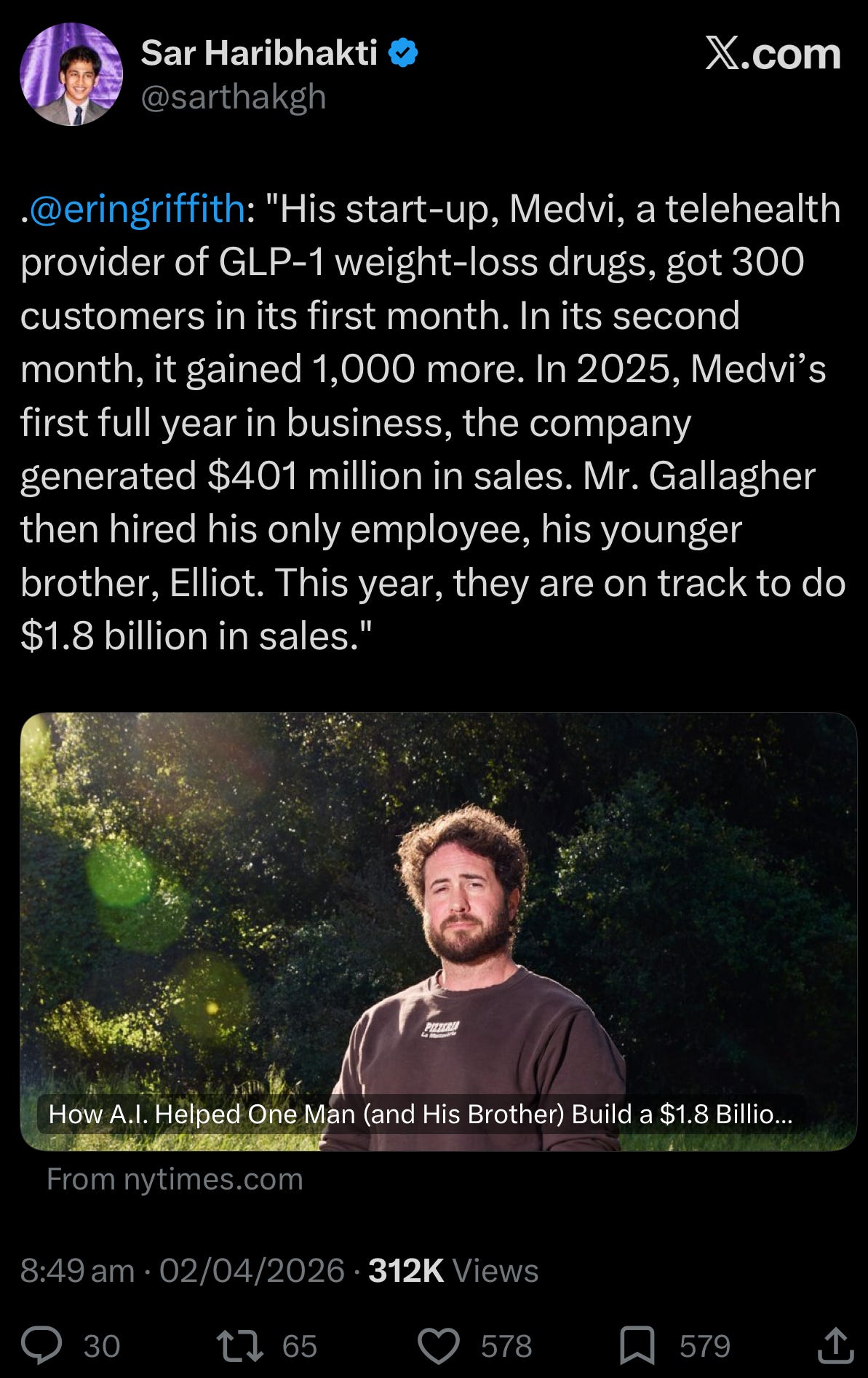
He outsourced doctors & pharmacy fulfillment to existing Telehealth infrastructure platforms & focused entirely on acquisition.
His company Medvi wasn’t built in the traditional sense.
He found a gap, the distance between what pharma charges & what people will pay, & automated the arbitrage.
There was no manufacturing, no proprietary molecule, no real IP.
Just pure distribution and one employee in LA.
I’m extremely skeptical of the 1.8BN number, especially after finding out the dude was shilling glp-1s through 800 fake doctors on facebook marketplace,
BUT.. if one person can build an successful telehealth company in two months with $20K, the model itself will definitely become a commodity.
Gaps ALWAYS close. & this one is closing fast.
Look at TrumpRX, it is driving GLP-1 prices down toward $350/month.
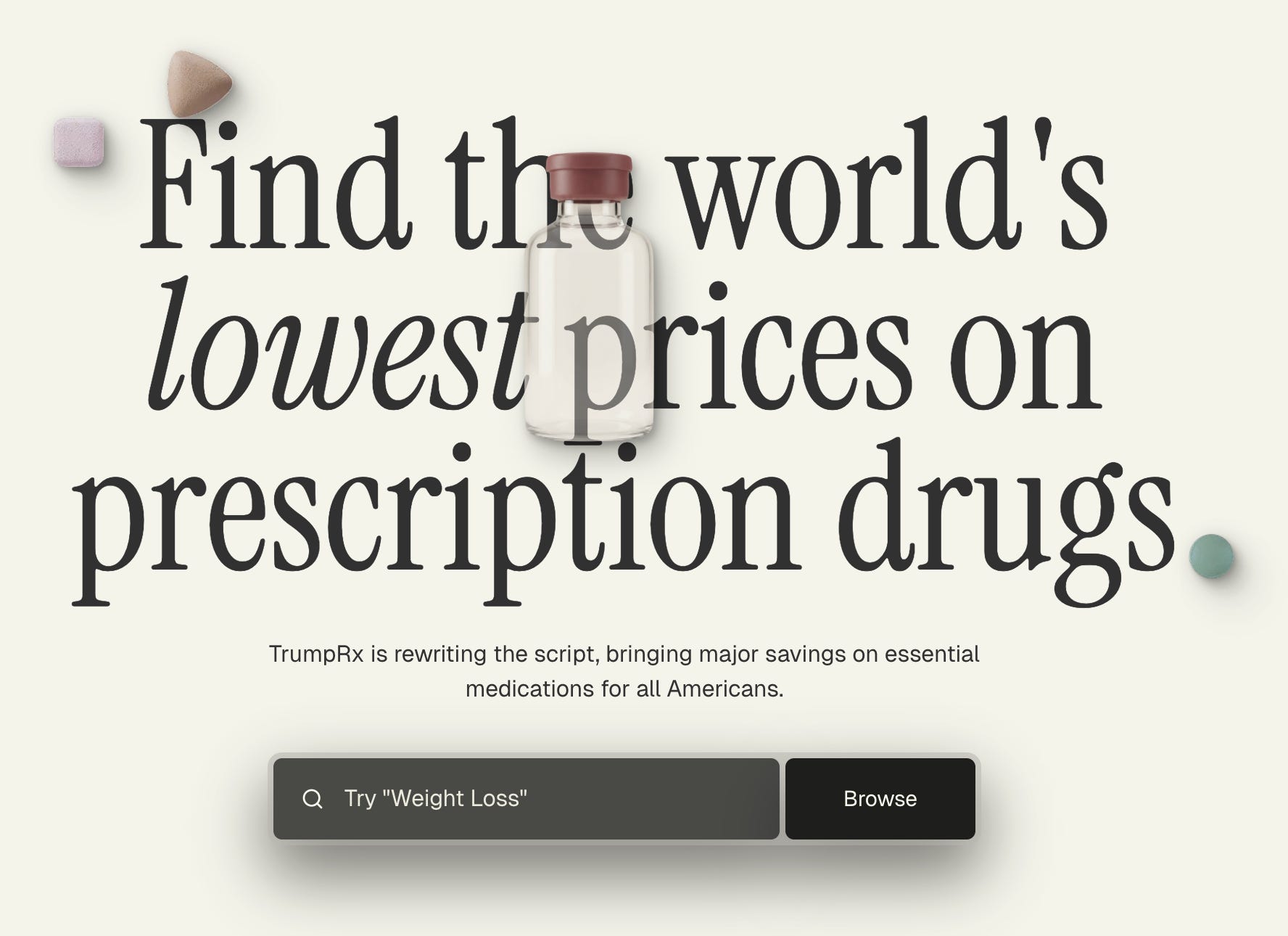
& the FDA is coming hard after the telehealths, just last week they warned 30 telehealth companies against marketing GLP-1s.
The shortage window that made all of this legal is over.
Hims saw this coming.
& that’s the difference between them & everyone else.
A lobbyist on the Hims team told me the reason they dropped $1 million on Trump’s inauguration was access - face time with the administration.
They know how to play the game.
The acquisition of MedisourceRx, a 503B outsourcing facility in California, transformed Hims from a distributor into a manufacturer.
They followed it with CS Bio for domestic peptide manufacturing, Trybe Labs for diagnostics, YourBio Health for at-home blood sampling.
They own the manufacturing, the testing, the data, the patient relationship.
$149 million in 2020 to $2.35 billion in full year 2025 revenue is 15x in five years.
By the time the GLP-1 shortage window closed, Hims had already stopped being a distribution play.
The recent Novo partnership was a pretty interesting signal.
Novo filed a massive lawsuit against Hims on Feb 9th unlawfully marketing knock-off Wegovy and Ozempic, & then about a week after all the threats, they struck up a partnership.
& now Novo uses Hims as a distribution platform.
Hims honors the FDA approval process for approved drugs & handles compounded versions for patients who genuinely need them.
The logic is obvious in hindsight — Novo would wait six years to collect on a lawsuit & risk the patent being invalidated. Hims would carry the litigation as a permanent stock overhang. Neither outcome was good, so they joined forces.
I’m bullish on Hims, it is expanding into testosterone, menopause, longevity treatments, AI dietitians, trainers & therapists…
Every category where the insurance system fails people & cash-pay fills the gap.
& that gap is enormous.
In 2024 the big five insurance companies made 4x the revenue of the biggest five pharma companies. The entire cash-pay wave is a bet against that system continuing to work for people.
The DTC players who survive are the ones who stopped being distribution plays before the distribution advantage disappeared.
Hims is the clearest example of a company that used the GLP-1 window to fund something harder to replicate — manufacturing, data, patient relationships, vertical integration all the way down. Their recent Eucalytus acquisiton will put them in the European map as well.
But the Medvis of the world are a different story.
The model will work until it doesn’t. & right now, a lot of the conditions that made it work are changing simultaneously.
Prediction: The DTC market bifurcates. Vertically integrated players like Hims consolidate around the patient relationship & the manufacturing infrastructure. Pure distribution plays riding the GLP-1 wave either get acquired, pivot, or watch the margin compress to nothing. The ones who own the supply chain + the data remain standing.
These are the Instagram looksmaxxing influencers shilling peptides on their stories, the Telegram group chats, the shady DTC sites that let you order peptides without an NPI number. No prescriber relationship, no medical screening, no age verification.
Just a consumer self-diagnosing, self-selecting, & injecting whatever showed up in the mail from a warehouse no one inspected.
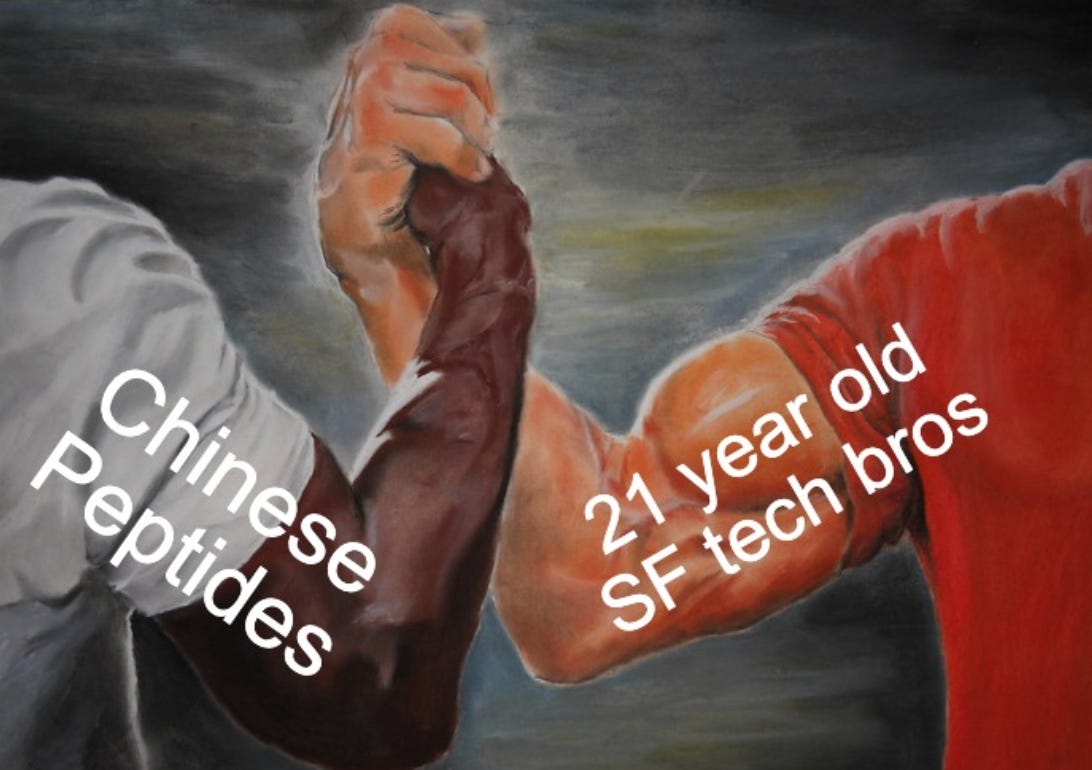
If you’ve watched Game of Thrones, you know Ned Stark who loses his head in the first season.
That’s this player.
Peptide Sciences, the largest research peptide vendor in the country with $7.4 million in online sales in December 2025 alone shut down voluntarily a few weeks ago. Word is they’re pivoting slightly under a new legal entity.
Amino Asylum didn’t get that choice. FDA agents raided their warehouse in June 2025 & the site is still offline nine months later.
Many RUO companies are now losing their payment processors entirely, which is a death sentence for an e-commerce business.
Even Amazon stopped selling bacteriostatic water, which end users use to reconstitute lyophilized peptides.
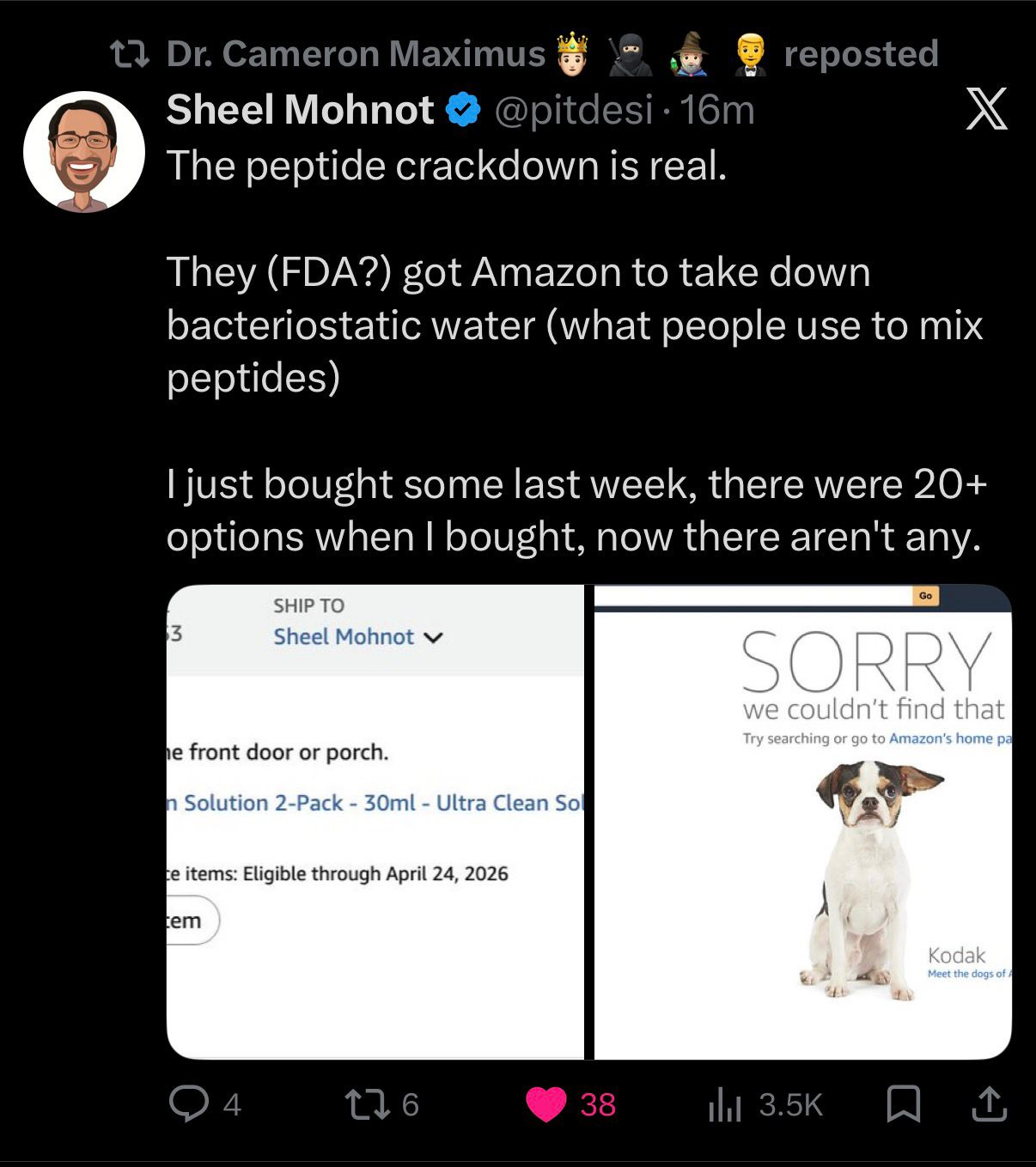
& then this week, US Customs & Border Protection in Cincinnati intercepted approximately 5,000 individual shipments of unapproved peptides smuggled from China. Retatrutide, semaglutide, tirzepatide, MOTS-C, TB-500, Semax, cagrilintide — all pre-labeled with actual US delivery addresses, each master carton concealing around 15 unmanifested packages. CBP has now intercepted over 300 of these smuggling attempts since identifying the scheme.
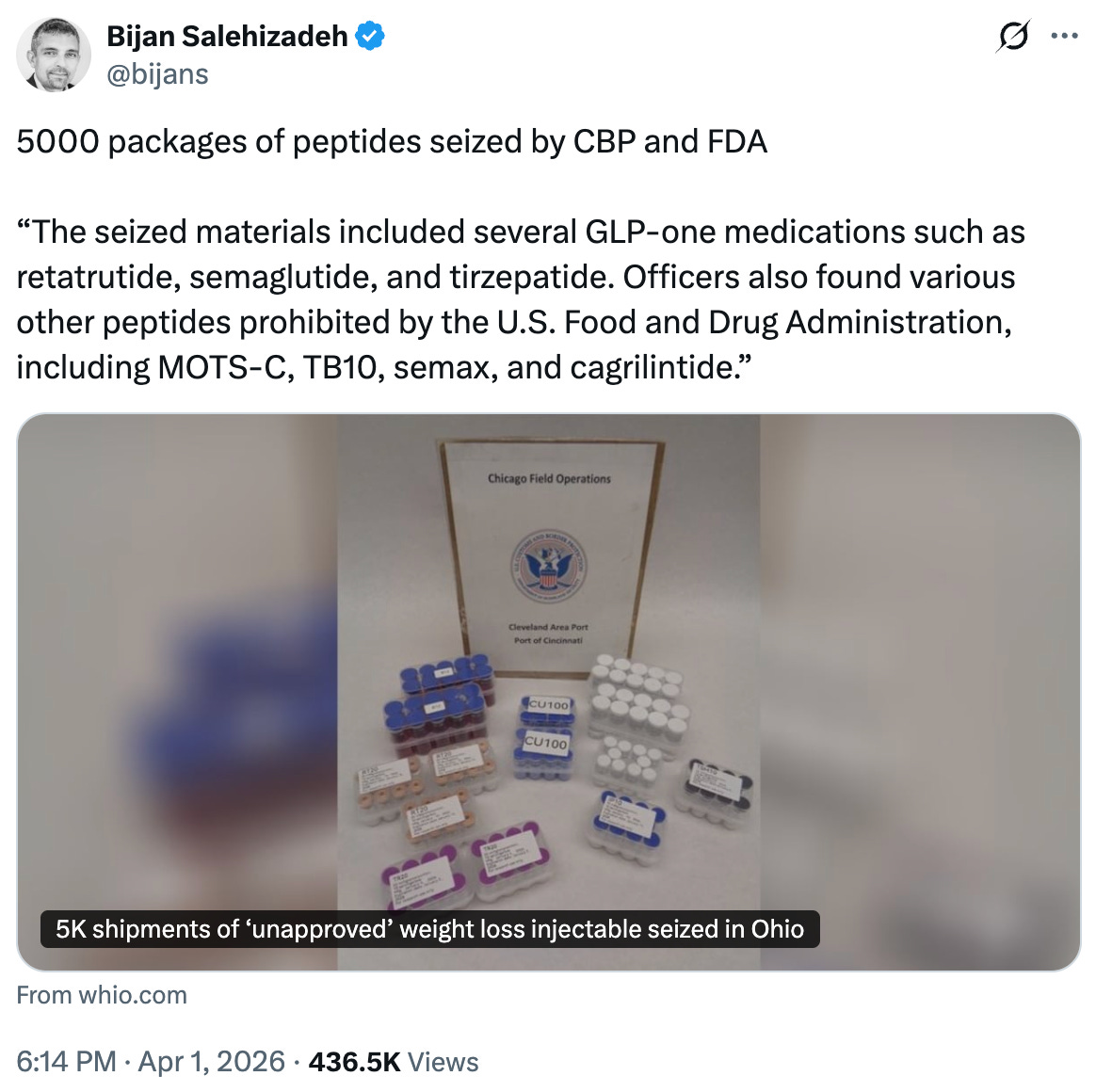
This market scaled so fast that quality infrastructure never had a chance to keep up. Finnrick Analytics, a peptide testing company out of Austin, tested 5,000+ samples from 173 vendors & found that 8% had measurable levels of endotoxins. Two women were hospitalized & placed on ventilators after receiving peptide injections at a longevity conference in Las Vegas in 2025.
These aren’t edge cases anymore.
What’s worth sitting with though is that the grey market didn’t create itself.
Rep. Harshbarger wrote to RFK Jr in November 2025 making exactly this point — that restricting physician-guided compounding risks driving patients into unsafe markets. Which is obviously what happened.
When the legitimate channel closes, people don’t stop wanting the product.
They just find a sketchier version of it.
Prediction: The visible grey market largely disappears over the next 18 months. The large ad-spend RUO sites either get raided, lose payment processing, or follow Peptide Sciences & shut down voluntarily.
The underground demand doesn’t disappear, it just gets harder to find.
Probably nobody.
At least not yet.
China is the closest thing to a winner right now & most people in this debate aren’t really talking about them.
But Trump’s recent tariffs on pharmaceuticals leads me to believe that they are also vying for the throne, & they might end up as the dark horse that ends up commanding a ton of marketshare.
Big Pharma probably comes in second or third.
Lilly specifically is playing a longer game than the peptide community gives them credit for — using the GLP-1 windfall to quietly acquire every adjacent human system while the MOU activates state by state crushing the smaller 503A compounders.
The rest of the players are still fighting for position.
If you’ve heard of the Gartner hype cycle, you’d understand that every transformative technology follows the same arc.
First, a trigger sparks initial excitement & capital starts paying attention.
Then, there’s a parabolic rise toward the peak of inflated expectations — the forecasts get completely detached from reality, everybody wants in, the market goes crazy.
Think the dot-com bubble in 1999.
NFT’s.
Metaverse.
Valuations that made no mathematical sense.
After the peak comes the trough of disillusionment.
The bubble corrects.
The overhyped things get exposed & the market capitulates.
Everyone who got in at the peak gets wrecked.
Then slowly the things that actually work start climbing the slope of enlightenment — real use cases emerge, the technology gets democratized, adoption spreads beyond the early believers.
Eventually you reach the plateau of productivity.
Mainstream. Sustainable.
Usually priced below the peak but significantly higher than the trough.
Think Amazon after the dot-com crash.
The companies that survived the trough owned the plateau.
Peptides are somewhere between the tech trigger & the peak right now.
The RFK announcement on Joe Rogan was the trigger.
The peak is close, & the trough will follow.
The thing about megatrends is that you could have invested in the internet in 1995, watched it collapse in 2001, & still made extraordinary returns if you held the right companies through the trough.
The theme was persistent.
The people who understood the difference between the bubble & the underlying shift — who exited before the crash & re-entered on the slope of enlightenment — made generational returns.
The consumer demand for agency over biology is that kind of persistent theme.
The trust collapse in traditional healthcare is not going away.
Peptides are a symptom of something much larger.
The operator who builds the verifiable supply chain through the trough — green-listed API, US manufacturing, third-party sterility testing, physician oversight, systematic outcomes data — owns the category at the plateau.
That company doesn’t fully exist at scale yet.
The throne is still empty.
No posts