Educational guide
Do Peptides Really Last at Room Temperature? A Community ...
One of the most common questions in the peptide research community is about storage and stability. We’ve all heard the recommendations: keep your peptides frozen, store them in the fridge, avoid light and heat. But what actually happens when peptides sit at ro
This guide cannot diagnose a condition or recommend a personal treatment plan. Discuss medical questions with a qualified professional.
One of the most common questions in the peptide research community is about storage and stability. We’ve all heard the recommendations: keep your peptides frozen, store them in the fridge, avoid light and heat. But what actually happens when peptides sit at room temperature for months?
A group of researchers in a Telegram community decided to find out—and they did it the right way.
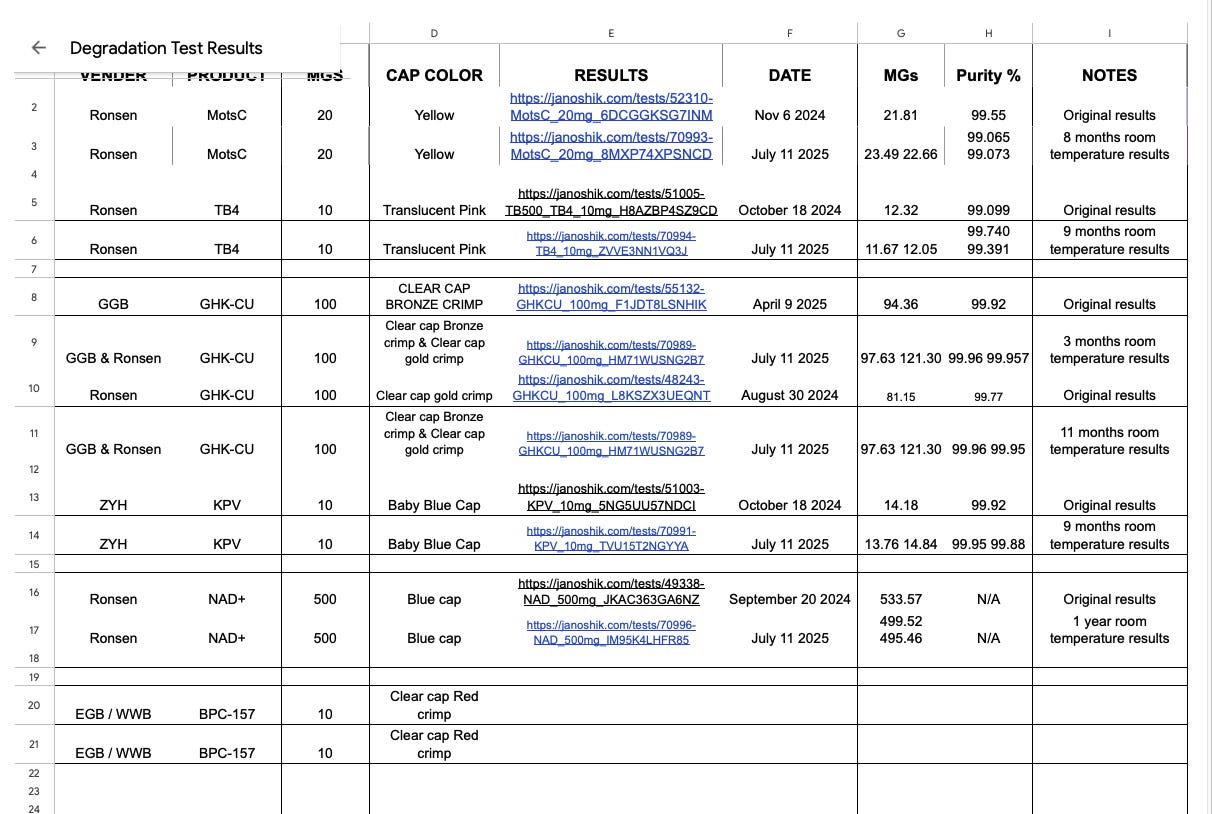
Here’s how they set it up: They purchased two identical vials of each peptide from the same vendor and batch. One vial was sent immediately for third-party testing at Janoshik to establish baseline purity and content. The second vial was left sitting at room temperature.
Months later—ranging from 3 months to a full year depending on the peptide—they sent that second vial in for testing.
This gives us a true apples-to-apples comparison: same product, same batch, same lab, different storage conditions over time.
Vial 1 — Tested fresh (November 2024):
Purity: 99.55%
Content: 21.81mg
Vial 2 — Tested after 8 months at room temperature (July 2025):
Purity: 99.07%
Content: 22.66mg average
Verdict: Virtually no degradation. The purity dropped less than half a percent over 8 months of room temperature storage.
Vial 1 — Tested fresh (October 2024):
Purity: 99.10%
Content: 12.32mg
Vial 2 — Tested after 9 months at room temperature (July 2025):
Purity: 99.39%
Content: 12.05mg average
Verdict: Rock solid. The slight purity “increase” is within normal measurement variance—essentially this peptide showed zero degradation over 9 months at room temp.
This one had the most data points:
Vial 1 — Tested fresh (April 2025):
Purity: 99.92%
Content: 94.36mg
Vial 2 — Tested after 3 months at room temperature (July 2025):
Purity: 99.96%
Content: 121.30mg (this was an overfilled vial)
Vial 3 — Tested after 11 months at room temperature (July 2025):
Purity: 99.95%
Content: 121.30mg
Verdict: Exceptional stability. GHK-Cu appears to be one of the more stable peptides, showing essentially zero purity loss even after nearly a year at room temperature.
Vial 1 — Tested fresh (October 2024):
Purity: 99.92%
Content: 14.18mg
Vial 2 — Tested after 9 months at room temperature (July 2025):
Purity: 99.88%
Content: 14.84mg average
Verdict: Excellent stability. A 0.04% purity drop over 9 months is negligible.
Vial 1 — Tested fresh (September 2024):
Purity: N/A
Content: 533.57mg
Vial 2 — Tested after 1 year at room temperature (July 2025):
Purity: N/A
Content: 495.46mg
Verdict: This is the most interesting result. While purity wasn’t measured, we see about a 7% content loss over a full year at room temperature. Still, the vial retained 93%+ of its content after 12 months in suboptimal conditions—far better than many would expect.
A few key takeaways from this community research:
1. Peptides are more stable than we often assume. The data shows that most peptides tested maintained 99%+ purity after 8-11 months at room temperature. The doom-and-gloom predictions about rapid degradation don’t seem to match reality for lyophilized (freeze-dried) peptides in sealed vials.
2. Not all peptides are equal. NAD+ showed more degradation than the smaller peptides. Molecular complexity and structure likely play a role in stability.
3. Lyophilized form matters. These were all freeze-dried powders in sealed vials. Reconstituted peptides in solution are a different story entirely—those should absolutely be refrigerated and used relatively quickly.
4. Real-world conditions aren’t as catastrophic as feared. If you’ve ever worried about a vial that sat in a mailbox on a warm day or stayed at room temp for a few weeks, this data suggests you’re probably fine.
Before you abandon your freezer entirely, some important notes:
This was a small sample size from specific vendors
“Room temperature” can vary significantly (a climate-controlled 70°F room vs. a hot garage are very different)
Proper storage (refrigeration or freezing) is still best practice for long-term storage
These results apply to lyophilized powder only—reconstituted peptides should always be refrigerated
Different batches and manufacturers may have varying stability profiles
This community-driven research provides something we don’t often get in this space: actual data with proper methodology. By testing two separate vials from the same batch—one immediately, one after extended room temperature storage—we get a true comparison of how these peptides hold up over time.
And that data suggests that quality lyophilized peptides are considerably more robust than conventional wisdom might suggest.
Does this mean you should store your peptides at room temperature? No. Refrigeration and freezing are still the gold standard for maximizing shelf life.
But if you’ve been stressing about temperature excursions during shipping, a vial that accidentally sat out for a while, or whether your peptides are still good after some time in less-than-ideal conditions—this data should give you some peace of mind.
The research community continues to generate valuable real-world data like this. It’s one of the things that makes this space so interesting—people aren’t just blindly following assumptions, they’re testing them.
Have questions about peptide storage or want to see more community research like this? Drop a comment below.
No posts